
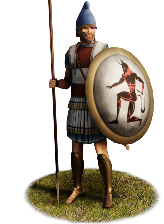
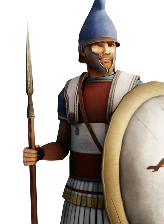
Description
The basis of all military power in Greece once revolved around the hoplite. Operating in the close formation known as the phalanx, they made up the main body of any Greek army. The hoplite of the 3rd century has been influenced by the many wars and alliances that different poleis had with Macedon, the Diadochi, and various other powers all around the Mediterranean. Thus, despite these hoplites maintaining a similar armament, including the dory (a 2-3m/6-9 ft spear); the iconic round aspis (shield); and a backup sword; they do show individual differences in their equipment. Their bronze helmets, either shiny or painted, have cheek pieces, and entail the Chalcidian, Phrygian, Attic, or Pilos types. For body armour, they wear differently coloured and crafted linothoraces and pteryges, and some wear bronze greaves as leg protection. Because the hoplites constitute the main infantry unit of any polis, and are armed with spear and shield, they will hold their own in close combat against other infantry units and cavalry, or under fire by missile troops. However, they are easily outclassed by professional troops, picked soldiers, or numerically superior skirmishers, and should thus be supported by other unit types in any serious battle.
Historical background
The hoplite phalanx was made up of the citizens of a polis who had the wealth to afford weapons and armour and thus either owned plots of land or worked in well-payed professions (Bardunias, Hoplites at War (2016), p. 66). The age of service ranged from entry into adulthood to 50, though the mobilisation of the entire demos, including younger ephebes or the veterans up to 60, was possible in rare occasions of crisis (Sekunda & Hook, Greek Hoplite 480-323 BC (2000), pp. 18-19). Though they initially did not receive payment, since military service was seen as a duty to the polis in exchange for political freedom; some poleis, like Athens, Pergamon, and Sparta, introduced wages at various points, and others followed suit. These occurred mostly after the Peloponnesian Wars, especially due to the rising importance of mercenaries, but payment could be quite unreliable (Pritchett, The Greek State at War. Part 1 (1971), pp. 23-29).
Making up the main body of any Greek army, hoplites needed light infantry and cavalry to act as mobile units around them, while they clashed with the main line of the enemy’s infantry. As Iphikrates puts it in Plutarch’s Pelopidas: “… the light-armed troops are like the hands, the cavalry like the feet, the phalanx itself is like chest and cuirass, and the general is the head" (Plut. Pel. 2.13). That means that hoplites were easily outmatched or intimidated by light infantry or cavalry if they had no such troops of their own (Konijnendijk, Classical Greek Tactics, 2017). The advent of the Macedonian sarissa phalanx and heavy shock cavalry, combined with the decisive victory of Philip II of Macedon (382-336 BC) at Chaironeia in 338 BC, signalled the end of the great era of the Hoplite. Yet, they would continue to function as the basic militia force of the Greek poleis (Gehrke, "Hoplitai”, in: Der Neue Pauly; Bardunias, Hoplites at War (2016), pp. 35; 70).
Who can recruit it
A core roster unit for 16 factions, each able to raise it anywhere they hold the right building:
Acragas · Argos · Byzantium · Chios · Cius · Epirus · Histria · Megalopolis · Messene · Pontic Pentapolis · Seleucid Empire · Seleucid Rebels (Asia Minor) · Seleucid Rebels (Upper Satrapies) · Selge · Thessalian League · Trapezus
Any faction holding one of the provinces below can field it.
Exactly what a settlement must have, route by route (13)
Areas of recruitment
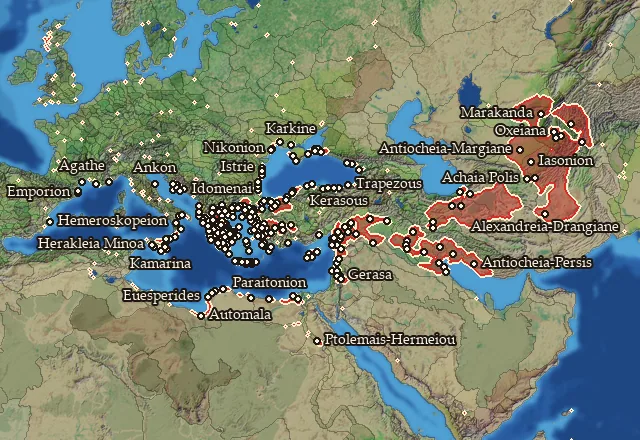
| Zone | Provinces | ||||||
|---|---|---|---|---|---|---|---|
| Greek | 263 |
Stats
| Rank in roster | ||
|---|---|---|
| Men per unit | 40 | ███······· 30% |
| Attack | 9 | █········· 13% |
| Charge bonus | 13 | █████····· 52% |
| Defence | 41 | ████████·· 76% |
| · armour | 10 | █████····· 54% |
| · defence skill | 26 | ████████·· 78% |
| · shield | 5 | ██████···· 57% |
| Morale | 10 | ███······· 29% |
| Discipline | Low | |
| Training | Highly trained | |
| Recruitment cost | 1,647 dn | ███······· 27% |
| Upkeep per turn | 603 dn | ████······ 42% |
| Turns to recruit | 2 |
Weapons
| Primary | Secondary | Primary | Secondary | Primary | Secondary | Primary | Secondary | ||||
|---|---|---|---|---|---|---|---|---|---|---|---|
| Attack | 9 | — | Charge bonus | 13 | — | Type | melee · blade | — | Damage | piercing | — |
| Properties | Light spear (braced against cavalry charges from the front) · +8 attack against cavalry | — |
Defence
| Primary | Secondary | Primary | Secondary | Primary | Secondary | Primary | Secondary | ||||
|---|---|---|---|---|---|---|---|---|---|---|---|
| Total | 41 | — | Armour | 10 | — | Defence skill | 26 | — | Shield | 5 | — |
Condition and terrain
| Hit points | 1 | Ground: scrub / sand / forest / snow | -1 / -1 / -4 / -1 | Charge distance | 30 | Formations | Square |
Technical stats
| Time between blows (primary / secondary) | 2.5 s / — | Extra fatigue in hot climates | 1 | Collision mass per man (1.0 is normal) | 1.12 | Spacing between men: close / loose | 1 × 1.05 m / 2 × 2.4 m |
| Default ranks | 5 |
In battle: Can sap · Very good stamina