
Mercenary Lycian Drepanophoroi
Mercenary. Hired from a regional pool, not recruited from a building.
Class: light · Category: infantry · Men per unit: 40
Description
''And Hector shouted aloud and called to the Trojans: ‘Ye Trojans and Lycians and Dardanians, that fight in close combat, be men, my friends, and bethink you of furious valour’.'' – (Iliad, ll. 8.172-175)
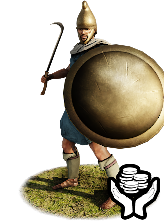
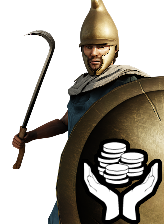
The Lycians are renowned as melee warriors throughout the Mediterranean world. Their specialty is the drepanon, a scythed sword somewhat similar to a sickle, which they wield with great precision and dexterity to cut open the bodies of animals or humans alike. The drepanophoroi are named after this weapon, and they are a terrible sight to behold. Since they only wear green, blue, or white tunics and leggings, they are better used in attack than in defence. Round, Greek-style aspis shields and Phrygian helmets or caps give them some protection in battle, but the drepanophoroi are still light enough to charge the enemy at speed. The daggers on baldrics and the elaborate designs on their shields show that they have respectable means to arm and equip themselves, and these soldiers thus proudly represent Lycian society and Lycian values. These include valour, loyalty, and athleticism, making them an effective unit on any battlefield.
Historical background
Lycia, a rugged landscape in southwestern Anatolia, had deeply rooted connections to the Greek world from the 2nd millennium BC onwards. As the introductory quote above shows, Homer was already well familiar with them, and the Lycians under their king Sarpedon were the most important allies of the Trojans during the war over Ilion (Dio Chrys. 11.94). Relations with their western neighbours are attested throughout the following centuries, and in the 6th century BC Lycia became subject to the Persians around the same time as Caria and Ionia (Hdt. 1.176). The flourishing major towns of Lycia such as Xanthos, Limyra, Telmessos, Phaselis, Myra, Olympos, and Patara continued to be ruled by local dynasts, however. These kept a close eye on developments in the Aegean, and when their Achaemenid overlords were defeated at Salamis and Plataiai, the rulers of Lycia, though not openly rebelling against Persia, concluded alliances with the victorious Athenians and their Delian League (Bryce/Zahle, Lycians (1986), pp. 103-107). The dynasts of Xanthos subsequently dominated the region, and their monumental graves can now be seen in the museum of another empire – the British Museum: somewhat fitting, and certainly not surprising.
In the 370s BC, Perikles of Limyra challenged the supremacy of the Xanthians and declared himself king of Lycia, thereby causing the Great Lycian War. After besieging Telmessos and Phaselis, Perikles was able to secure half of the Lycian Peninsula. However, as Liam Neeson taught us, there is always a bigger fish. During the subsequent Great Satrap Revolt against the Persians (366-360), both Perikles and the Xanthians were unsuccessful in defeating the other, and thus weakened, they fell prey to the mighty satrap Mausolos of Caria (r. 377-353 BC). Mausolos and his successors ruled over both Caria and Lycia, with the dynasts being restricted to their cities and subjected to a Carian administrator (Klinkott, Der Satrap (2005), pp. 121-22). After the end of the Hekatomnid dynasty in the late 4th century BC, Lycia passed first into the hands of Alexander and then those of the Ptolemaic Kingdom.
Between 385 and 370 BC, one of the lesser Lycian dynasts, either one Trbēnimi or one Mithrapata, erected a heroon (“hero temple”) in the small town of Trysa, near Myra (Landskron, Das Heroon von Trysa (2015), pp. 352-60). The rectangular building is 20m long and 23m wide and decorated with impressive friezes depicting almost 600 figures from mythology, history, and contemporaneous society (Noll, Das Heroon von Gölbaşi-Trysa (1971), p. 2; Landskron (2015), p. 13). One of the friezes shows three Lycian infantrymen with equipment typical for the 4th century BC. All of them are clothed in simple, possibly blue and white tunics, but they carry round aspis shields in their left hand and a drepanon each in their right hand. One of the Lycians wears only a Phrygian cap for protection, while the other two warriors have helmets on their heads, one of them crested (Head, Persian Army (1992), fig. 43b). Aspis shields, helmets, and pale, blueish tunics as features of Lycian soldiers date back at least a century earlier, as they also appear on the Karaburun II tomb. This grave of an influential nobleman or dynast was found in Elmali, close to the small ancient settlement of Podalia, itself situated north of Arykanda (Keen, Dynastic Lycia (1998), pp. 230-231). The soldiers on the Karaburun tomb, too, lack body armour (though they wear leggings), but they fight with spears, not with the drepanon. One of these men also sports a dagger on a baldric (Head (1992), fig. 43a). The drepanon was probably a weapon typical for all Caria and Lycia, and as it is already described by Herodotus, it might have existed by the beginning of the 5th century BC, but it only became common in iconography in the 4th century BC (Keen (1998), p. 230).
It then seems sensible enough to assume that, if Lycians fought the same way in 470 and 370 BC, that they would still have fielded light infantry equipped with aspis shields and the drepanon in 270 BC, when the RIS campaign begins. We have thus armed the drepanophoroi (“drepanon bearers”) exactly as the evidence suggests: with light blue, white, or green tunics (Head (1992), pl. 7 (p. 50) reconstructs them in green), leggings, aspis shields, drepanoi, daggers on baldrics, and a mix of Phrygian helmets and Phrygian caps. Such troops were probably effective when attacking the flanks of the enemy infantry, when charging unarmoured enemies, or when storming city walls.
Stats
| Rank in roster | ||
|---|---|---|
| Men per unit | 40 | ███······· 30% |
| Attack | 10 | ██········ 19% |
| Charge bonus | 12 | ████······ 42% |
| Defence | 25 | ███······· 28% |
| · armour | 2 | █········· 13% |
| · defence skill | 18 | ████······ 38% |
| · shield | 5 | ██████···· 57% |
| Morale | 11 | ████······ 39% |
| Discipline | Normal | |
| Training | Trained | |
| Upkeep per turn | 572 dn | ████······ 35% |
Weapons
| Primary | Secondary | Primary | Secondary | Primary | Secondary | Primary | Secondary | ||||
|---|---|---|---|---|---|---|---|---|---|---|---|
| Attack | 10 | — | Charge bonus | 12 | — | Type | melee · blade | — | Damage | slashing | — |
Defence
| Primary | Secondary | Primary | Secondary | Primary | Secondary | Primary | Secondary | ||||
|---|---|---|---|---|---|---|---|---|---|---|---|
| Total | 25 | — | Armour | 2 | — | Defence skill | 18 | — | Shield | 5 | — |
Condition and terrain
| Hit points | 1 | Ground: scrub / sand / forest / snow | 0 / 0 / 0 / 0 | Charge distance | 30 | Formations | Square |
Technical stats
| Time between blows (primary / secondary) | 2.5 s / — | Extra fatigue in hot climates | 0 | Collision mass per man (1.0 is normal) | 0.95 | Spacing between men: close / loose | 1 × 1.2 m / 2 × 2.4 m |
| Default ranks | 5 |
In battle: Can sap · Very good stamina
Where to hire it
Mercenaries are hired from a regional pool, not recruited from a building. This unit is offered by 3 pools covering 19 regions, at 3,163–3,543 dn to hire and 0–1 experience.
Mercenary pools: Alexandria · Crete · Lycia
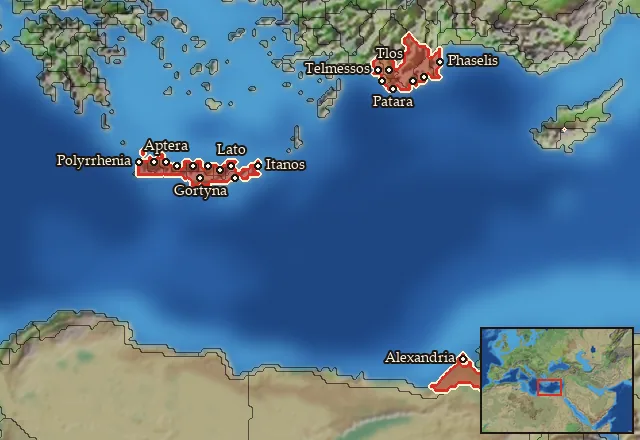
At least one of those pools sells to any faction that has an army in range, with no faction restriction.
Some pools additionally restrict it to Ptolemaic Empire · Ptolemaic Rebels.