
Mercenary Prienian Hoplites
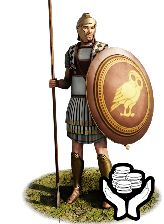
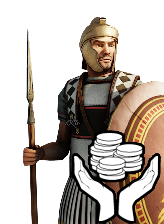
Mercenary. Hired from a regional pool, not recruited from a building.
Class: spearmen · Category: infantry · Men per unit: 40
Description
These hoplites are proud citizens of Priene, the self-proclaimed capital of the Ionian League. Situated in the heartland of Greek culture in Asia Minor, Priene controls the Panionion, the central sanctuary of Ionia. Despite its small size, the polis is of great significance for the Greek world and retains cultic and economic ties to places as far away as Italy or Nabataea. Its society is famously egalitarian, and its citizens thus take great pride in their polis. The hoplites are armed with their traditional spear, the dory, a xiphos sword for melee, uncrested Attic and pilos helmets, greaves, and linen cuirasses (linothorakes). Having trained in full armour since their teenage days, they are well prepared for the terrors of war.
Historical background
Priene was founded by Carians on the northern shores of the Latmian Gulf in times immemorial (Paus. 7.2.10). In the 8th century BC, Theban and Ionian settlers arrived and transformed it into a Greek city that quickly joined the prestigious Ionian League (Rumscheid, s.v. Priene, DNP Online, 2006). Ionia was the birthland of the Greek mind, of philosophy, mathematics, physics, and astronomy. Bias of Priene (ca. 590-530 BC) was counted among the Seven Sages. By his lifetime, Priene had gained control over the Panionion, the central sanctuary of the Ionian League. It controlled much land beyond the city walls, in the fertile valley of the Maeander as well as on the other side of the Mykale mountains, which towered above the city. The northern stretch of land encompassed the Panionion, the Carian fortress Karion, the booming market town Dryoussa, as well as most productive farmland, which Herodotus praised as one of the most verdant districts in the world (Hdt. 1.142).
Unsurprisingly, Priene's control over this land was contested by other powers, namely Samos, which declared war on the Prienians when they first took hold of the area. Bias of Priene himself eventually led an embassy to Samos which brokered a peace deal that would end two centuries of bloodshed (Plut. Moralia 296A = Aristot. Constitution of the Samians F576 Rose; CIG 2254). Not long after the return of the envoys, however, Alyattes II of Lydia (r. ca. 600-561 BC), father of the famous Kroisos, declared war on Priene, as he was eager to capture the city, its fertile land, and its access to the Latmian Gulf and thus the Aegean Sea. Soon, a huge Lydian army encircled Priene and began its siege. Bias, however, devised a ruse. Through informants, he spread the message that Priene's storehouses contained enough food for several years, and Alyattes decided to end the siege, for he did not think he could storm Priene's mighty walls. Peace was made, and Priene saved (Diog. Laert. 1.83).
Later, Priene would accept the authority of Kroisos and then the Persians, however, before it joined its rival Miletos, located on the southern shore of the Latmian Gulf, in the Ionian Revolt against Achaemenid rule (499-494 BC) (Hdt. 6.8.1). After the failure of the revolt and the subsequent Greco-Persian Wars, Priene was weakened and became a member of Athens’ Delian League (inscription Hiller no. 441, 442). These years were the darkest in Prienian history, and in 441/440 BC its old enemies Miletos and Samos fought over control of Priene (Thuc. 1.115.2). The Samians initially prevailed, but when envoys from Miletos complained about the anti-Athenian tendencies on Samos in Athens, the imperial hegemon intervened and punished the Samians (Thuc. 1.115.2-3). This was only the beginning of a longer revolt narrated in some detail by Thucydides in the following chapters, but it does not need to concern us here. Priene was seemingly too weak to defend itself at this time, and its citizens thus seem to have welcomed the end of Athens' dominion. In 397 BC, we find the Prienians supporting Sparta (Xen. Hell. 3.2.17), and in 373 BC, they restored the Panionion to all its glory and regulated that only citizens of Priene could become priests of the sanctuary (Diod. 15.49; Strab. 8.7.2C384).
More radical measures were necessary to revive Priene’s standing, however, and they were a direct reaction to what had probably plunged the once proud city into insignificance in the first place: the Maeander river, Greek Maiandros. The word meandering means winding, curving and comes from the course of the ancient river, which is now known as Menderes in Turkish – thus more or less retaining its original name. When Priene was founded as a Greek city in the 8th century BC, it sat at the northern side of the Latmian Gulf, which was formed by the mouth of the Maeander. It was a coastal town, and the coast would stretch northeast for a further 16 or 17 kilometres to the point where the river met the Aegean Sea. From there, the coast turned southwards until it met the city of Myos, where it retreated into the bay of Herakleia by Latmos, and then ran westwards to arrive at a point south of and nearly opposite of Priene, where Miletos was located. Thanks to its meandering, the Maiandros carried much soil towards its mouth and into the bay, however, and in the course of only 400 years, it had completely silted up the north-eastern part of the bay, some 200 km2. This meant that Priene and Myos were now not divided by the sea anymore, but connected by marshy land, and both towns had lost their role as ports (cf. Quint. Smyrn. Troy 10.145; Magie, Roman Rule in Asia Minor (2015), p. 78). This presented some obvious challenges to the polis and its economy, and the UNESCO World Heritage page – Priene was suggested as a site by Turkey in 2018 and is still under consideration – aptly summarises what happened:
As a result of the continual silting up of the Gulf through the river Maeander, Priene was rebuilt in the middle of the 4th cent. BC to the west of present-day Güllübahçe, below the Teloneia (c. 370 m high) on the muddy, southern slope of the Mycale promontory. Since then, the chṓra (territory) of Priene covered the eastern section of the Mycale as well as the plains to the south and north of the range (Source: Archaeological Site of Priene - UNESCO World Heritage Centre).
Thus, in the middle of the 4th century BC, the Prienians moved their whole city to the southern side of the Mykale mountains, just beneath the Teloneia, with a mighty acropolis sitting high above the new city. Priene was rebuilt according to the Hippodamian city plan, an idea devised by Hippodamos of Miletos (ca. 500-408 BC). An orthogonal grid of streets was accompanied by public buildings, including a stunning temple of Athena designed by the star architect Pytheos that was begun with the support of Mausolos, satrap of Caria, and finished with the help of Alexander the Great (Vitr.1.1.12; cf. Ault, Haus und Stadt im klassischen Griechenland (2017), p. 43). The renewed polis had its autonomy confirmed by Alexander and continued to be governed by a radical democracy, at a time when Athenian democracy had long acquired more aristocratic features (I.Priene 5.1-2; Rubinstein, Ionia (2004), p. 1092). The identity of the Prienian citizens was thus defined by their control of the Panionion, the survival in uncertain times, the reconstruction of the city, and a strong sense of egalitarianism, which stood out even in the Greek world. In the 1st century BC, A. Aemilius Zosimos, who was both a Roman and Prienian citizen and probably of Italiote (Greek Italic) origin, became stephanephoros, the chief magistrate of the city, and invited slaves, foreigners, and women to his house for a huge banquet where everyone was equal (Gray, Beyond the Classical Polis (2022), p. 212).
The hoplites of Priene were recruited from all of these citizens and would have fought for the civic values of their polis. One Hellenistic inscription from the gymnasion attests that the city’s ephebes, the sons of citizens roughly 16 to 18 years old, trained in the full armour of Hoplites (I. Priene 112, l. 72-76). Each year, Priene hosted the Kallihoplia, a competition over the most beautiful (hoplite) panoply the city state could offer. All of the ephebes were invited to participate and were thus further prepared and motivated for their life as hoplites (Kah, Militärische Ausbildung im Hellenistischen Gymnasion (2004), p. 66). In RIS, we have thus decided to arm the Prienian Hoplites in rather classical style: with aspis shields, spears, linothorakes, greaves, xiphos swords, and uncrested Attic or pilos helmets.
Stats
| Rank in roster | ||
|---|---|---|
| Men per unit | 40 | ███······· 30% |
| Attack | 9 | █········· 13% |
| Charge bonus | 13 | █████····· 52% |
| Defence | 41 | ████████·· 76% |
| · armour | 10 | █████····· 54% |
| · defence skill | 26 | ████████·· 78% |
| · shield | 5 | ██████···· 57% |
| Morale | 10 | ███······· 29% |
| Discipline | Low | |
| Training | Highly trained | |
| Upkeep per turn | 603 dn | ████······ 42% |
Weapons
| Primary | Secondary | Primary | Secondary | Primary | Secondary | Primary | Secondary | ||||
|---|---|---|---|---|---|---|---|---|---|---|---|
| Attack | 9 | — | Charge bonus | 13 | — | Type | melee · blade | — | Damage | piercing | — |
| Properties | Light spear (braced against cavalry charges from the front) · +8 attack against cavalry | — |
Defence
| Primary | Secondary | Primary | Secondary | Primary | Secondary | Primary | Secondary | ||||
|---|---|---|---|---|---|---|---|---|---|---|---|
| Total | 41 | — | Armour | 10 | — | Defence skill | 26 | — | Shield | 5 | — |
Condition and terrain
| Hit points | 1 | Ground: scrub / sand / forest / snow | -1 / -1 / -4 / -1 | Charge distance | 30 | Formations | Square |
Technical stats
| Time between blows (primary / secondary) | 2.5 s / — | Extra fatigue in hot climates | 1 | Collision mass per man (1.0 is normal) | 1.12 | Spacing between men: close / loose | 1 × 1.05 m / 2 × 2.4 m |
| Default ranks | 5 |
In battle: Can sap · Very good stamina
Where to hire it
Mercenaries are hired from a regional pool, not recruited from a building. This unit is offered by 1 pool covering 22 regions, at 3,090 dn to hire and 0 experience.
Mercenary pool: Ionia
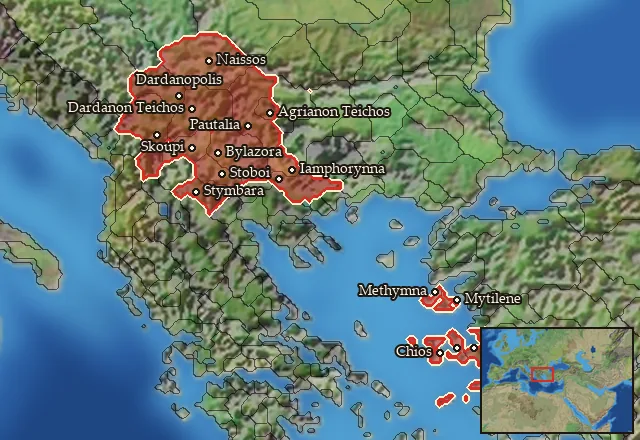
At least one of those pools sells to any faction that has an army in range, with no faction restriction.
The 22 regions where this unit appears in a mercenary pool
Agriania · Anatolike Dardania · Axios · Chios · Dardania · Denthelentike · Deuriopos-Pelagonia · Erigonia · Galabria · Ionia · Klazomenia · Latmikos Kolpos · Lesbos · Maidia · Methymnia · Mimas · Mykale · Naissitania · Nea Ionia · Paionia · Samos · Sintike-Odomantike