
Southern Illyrian Cavalry
Class: missile · Category: cavalry · Men per unit: 30
Description
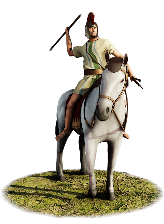
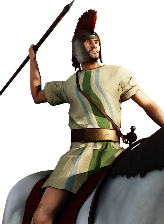
Southern Illyrian Cavalry are emblematic of the Illyrian way of war – they can skirmish adeptly with their javelins, or charge ferociously using their spears. They are not shock cavalry, however, as they are generally unprotected apart from their short Illyrian tunics to stay unencumbered. Only their heads are protected by Illyrian bronze helmets against blows that they cannot evade through horsemanship alone.
Historical background
The idea of the ‘Illyrians’ originated from two different Greek or Hellenic ideas. First, as concept to describe the areas of the eastern Adriatic coast and the peoples dwelling there, second to describe the western and northwestern neighbours of the Greeks and Macedonians more generally (Dzino, ‘Illyrians’ in ancient ethnographic discourse (2014), p. 47). It is likely that the coastal Illyrians were the first group of interest to the Greeks, as their early geographers such as Hecataios, Ephoros, and Erastotenes gave lengthy descriptions of the geography and societies of the Adriatic coast (Dzino, Appian's Illyrike (2016), p. 72). In Illyrian mythology, the Southern Illyrians started with the first generation of Illyrius' descendants, who “belong mostly to the group of the so-called South-Illyrian tribes: the Taulantii, the Parthini, the Enchelei, the Dassaretii” (Papazoglu, The Central Balkan Tribes in pre-Roman Times (1978), p. 213). These initial tribes evolved or were integrated into others, so few of these original tribes remain playable by the start of RIS’ timeframe in 270 BC.
The Southern Illyrians’ use of cavalry was recorded on several occasions amongst their contemporaries. The Parthini (not to be confused with the Parthians) were a Southern Illyrian tribe, who were settled in the Shkumbi valley and in the hinterland of Dyrrhachium. They were known for using horsemen, having contributed “two hundred horse of the Parthinians” in the Third Illyrian War to support King Genthius of Illyria (Liv. 44 30). The Parthini maintained a strong and organised military and appear to have been respectable enough horsemen to be used by Brutus as auxilia or mercenaries at the Battle of Philippi in 42 BC (Sasel Kos, Appian and Illyricum (2005), p. 370). Appian’s description of the battle (App. BC 4.11.88) included “3,000 Thracian and Illyrian” horsemen serving Brutus, so in revenge Antony went to war in 39 BC “against the Partheni, an Illyrian tribe near Epidamnos (Dyrrhachium), who had been very much attached to Brutus”, not to mention the Dardanians also (App. BC 5.75).
Another, more vivid example of Illyrian cavalry comes from even earlier, from the late 4th century BC when the Illyrians under King Bardylis set to invading and battering much of Macedon, Molossia, and Epirus. For some years no Greek or Hellene was safe, as in 385 BC Diodorus exclaimed that there was a “sharp battle in which the Illyrians were victorious and slew more than fifteen thousand Molossians” (Diodorus 15.13.3). In 359 BC, the Illyrian’s skill at integrating infantry, skirmishers, and cavalry resulted in them defeating and killing Phillip II’s (father of the later Alexander the Great) brother and ruling predecessor Perdikkas III, not to mention 4,000 or so Macedonians (Howe, Illyrian Influences on Argead Military Development (2017), p. 104). This rampage was only stopped by Philip II in 358 BC, who had reformed his army to use combined arms more closely resembling Bardylis’ troops. He soundly defeated the Illyrians, despite the efforts of Bardylis: “relying upon his previous victories and the gallant conduct of the Illyrians, [who] came out to meet the enemy with his army and he had ten thousand picked infantry soldiers and about five hundred cavalry” (Diod. 16.4 4-5).
The equipment of the Southern Illyrian Cavalry, much like most other Illyrian units, is a combination of Sibyna spears, javelins, and light protective equipment, but in this case, to be used whilst riding a horse. The name Sibyna refers to one of the few known words from Illyrian language, which referred to lances or hunting-spears (Wilkes, The Illyrians (1996), p. 69). Exhumations of tumulus complexes revealed multiple lances and spears, alongside axes and, most importantly, one also contained a horse bridle (Lippert, Die Illyrer: Kulture und Sprache eines alteuropaischen Volkes (2022), p. 62). Findings in Northern Serbia (often Dardanian territory) have shown various pieces of horse-riding equipment including buttons with a straight edge and a convex central part that is most often decorated with triskele motifs, as well as three foil-shaped strap separators with three semicircular perforated blades and a central round convex plate decorated with a triskele (Drnic, Segestan Warriors - Finds of Weapons and Horse-Riding Equipment (2018), p. 90). They also use the Illyrian helmet, which is pervasive in Illyrian factions, as those have been found throughout the Adriatic coast, in Albania, and into the Ohrid region (Wilkes (1996), p. 108).
Stats
| Rank in roster | ||
|---|---|---|
| Men per unit | 30 | █········· 8% |
| Attack | 10 | ██········ 19% |
| Charge bonus | 13 | █████····· 52% |
| Defence | 16 | █········· 10% |
| · armour | 3 | ██········ 21% |
| · defence skill | 13 | █········· 13% |
| · shield | 0 | █········· 0% |
| Morale | 7 | █········· 10% |
| Discipline | Normal | |
| Training | Untrained | |
| Recruitment cost | 1,301 dn | █········· 10% |
| Upkeep per turn | 524 dn | ██········ 23% |
| Turns to recruit | 2 |
Weapons
| Primary | Secondary | Primary | Secondary | Primary | Secondary | Primary | Secondary | ||||
|---|---|---|---|---|---|---|---|---|---|---|---|
| Attack | 10 | 6 | Charge bonus | 13 | 20 | Type | thrown · archery | melee · blade | Damage | piercing | piercing |
| Projectile | javelin | — | Range | 60 | — | Ammunition | 7 | — | Properties | Thrown | — |
Defence
| Primary | Secondary | Primary | Secondary | Primary | Secondary | Primary | Secondary | ||||
|---|---|---|---|---|---|---|---|---|---|---|---|
| Total | 16 | — | Armour | 3 | — | Defence skill | 13 | — | Shield | 0 | — |
Condition and terrain
| Hit points | 1 | Mount | light horse | Ground: scrub / sand / forest / snow | -1 / 0 / -7 / 0 | Charge distance | 40 |
| Formations | Square |
Technical stats
| Time between blows (primary / secondary) | 2.5 s / 2.5 s | Extra fatigue in hot climates | 0 | Spacing between men: close / loose | 2 × 4.8 m / 3.6 × 6.72 m | Default ranks | 5 |
In battle: Can form Cantabrian circle · Very good stamina
Who can recruit it
A core roster unit for 5 factions, each able to raise it anywhere they hold the right building:
Ardiaei · Delmatae · Illyrian Kingdom · Labeatae · Liburni
Any faction holding one of the provinces below can field it.
Exactly what a settlement must have, route by route (4)
| Building | Also requires | Building | Also requires | Building | Also requires | Building | Also requires |
|---|---|---|---|---|---|---|---|
| Any settlement | Garrison Building or Tier 1 Military Industrial Complex · Southern Illyrian area of recruitment · not Dardanian area of recruitment · Any Government (Dependency, Indirect Rule or Direct Rule) · Tier 2 Colony not built | Indirect Rule | Garrison Building or Tier 1 Military Industrial Complex · Tier 1 Colony | Direct Rule | Garrison Building or Tier 1 Military Industrial Complex · Tier 1 Colony | Homeland | Garrison Building or Tier 1 Military Industrial Complex |
Areas of recruitment
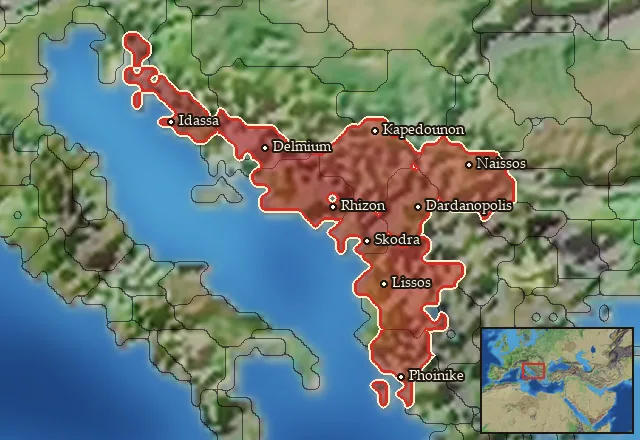
| Zone | Provinces | ||||||
|---|---|---|---|---|---|---|---|
| Southern illyrian | 9 |