
Grain Industry
3 levels, each replacing the one before it: you upgrade in place rather than building alongside.
Milling District (Urban) → Brewing Quarter (Urban) → Baking Guild (Urban)
Levels at a glance
| Level | Cost | Build time | Minimum settlement | Upgrades to | Level | Cost | Build time | Minimum settlement | Upgrades to | ||
|---|---|---|---|---|---|---|---|---|---|---|---|
 | Milling District (Urban) | 1,500 | 3 | large town | Brewing Quarter (Urban) |  | Brewing Quarter (Urban) | 3,000 | 4 | city | Baking Guild (Urban) |
 | Baking Guild (Urban) | 6,000 | 5 | large city | — |
Costs in denarii, build time in turns.
Milling District (Urban)
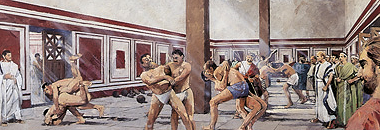
Grain goes in, flour (and life) comes out.
The Milling District spans entire quarters of the city, where countless grinding wheels work day and night. This industrial heartland draws grain caravans from across the realm, funnelling harvests through an intricate network of warehouses, water channels, and stone mills that never sleep. Here, master millers oversee armies of workers who sort, clean, and grind endless streams of grain into the flour that feeds tens of thousands. The district's maze of workshops, storage vaults, and transport canals forms the system that feeds its people, transforming seasonal harvests into year-round abundance. From the main mills powered by diverted rivers to the smaller neighbourhood operations serving local bakers, this milling district ensures no citizen goes without bread.
In a world fueled by grain, the mill is a quiet hero, ensuring every crumb is savoured by the grateful populace.
| Cost | 1,500 denarii | Build time | 3 turns | Minimum settlement | large town | Upgrades to | Brewing Quarter (Urban) |
Requirements: all of these must hold before this level can be built.
- Local Barter or a higher level is built here
- The region has Grain
- Only one urban industry building allowed
- Government Building (Dependency, Indirect Rule, Direct Rule or Homeland)
What it does
- +1 population growth
Brewing Quarter (Urban)
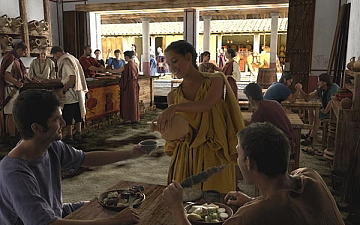
Where the city's flour is made ready.
Here, all the flour from many mills comes together. No longer just a collection of workshops but a meticulously planned industrial behemoth within the city. You see vast, multi-storied structures dedicated to the advanced cleaning, sifting, and mixing of flour, ensuring a consistent quality that feeds a metropolis. Conveyor systems transport the processed flour directly into storage silos, each capable of holding enough to feed an army for a month. Workers watch over everything, making sure it all runs smoothly. This is where raw grain turns into good flour, ready to go to the city's bakeries.
It's the step between the fields and the bread people eat every day.
| Cost | 3,000 denarii | Build time | 4 turns | Minimum settlement | city | Upgrades to | Baking Guild (Urban) |
Requirements: all of these must hold before this level can be built.
- Local Market or a higher level is built here
- The region has Grain
- Government Building (Dependency, Indirect Rule, Direct Rule or Homeland)
What it does
Show 10 effects that apply only in some circumstances
- +1 population growth, only when you do not play a Greek, Roman or Western Hellenistic faction
- +2 population growth, only when you play a Greek, Roman or Western Hellenistic faction
- +6 taxable income, only when the region's water source is not River and you play a Greek, Roman or Western Hellenistic faction
- +6 taxable income, only when the region's water source is not River and you do not play a Greek, Roman or Western Hellenistic faction
- +6 taxable income, only when the region's water source is River and you do not play a Greek, Roman or Western Hellenistic faction
- +10 taxable income, only when the region's water source is River and you play a Greek, Roman or Western Hellenistic faction
- +2 public order (happiness), only when you do not play a Greek, Roman or Western Hellenistic faction
- +1 trade income, only when you do not play a Greek, Roman or Western Hellenistic faction
- Additional tax bonus due to a river allowing for a watermill, only when the region's water source is River and you play a Greek, Roman or Western Hellenistic faction
- Additional happiness and trade bonus, as people of your culture enjoy beer. But no watermilling tax bonus, only when you do not play a Greek, Roman or Western Hellenistic faction
Baking Guild (Urban)
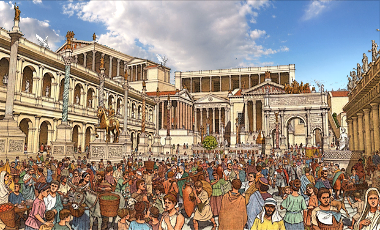
Bread so fresh and soft, it’ll make your legions weep.
The Baking Guild District represents a vast confederation of ovens, workshops, and distribution centers that ensures fresh bread reaches every neighborhood before dawn breaks. Master bakers coordinate enormous operations where hundreds of workers press, shape, and bake these goods in carefully timed shifts. Massive communal ovens, some large enough to bake for entire districts, dominate the skyline with their tall chimneys. Networks of apprentices and delivery carts spread out like arteries from these centres, carrying warm loaves to markets, homes, and temples across the region.
History:
In 171 BC, during the Third Macedonian War, the arrival of Greek bakers established the first professional bakers, known as the pistores, in Rome. It was in ancient Rome where bread and pastries first began to be mass-produced.
Archaeological research conducted in Britain identified five different kinds of Roman baking, including baking in the ashes, baking surrounding hot ashes, the sub testu method, and baking in earthenware vessels. The most basic method of baking was cooking in ashes. The hot ashes and tiles were used to heat the bread. The sub testu method involved baking bread underneath a hot cover or hot coals. These baking covers are typically ceramics with pie-shaped lids and foot-long sides. Although none of the examples have handles or holes at the top, some have flanges on the sides. Bread could also be cooked in earthenware vessels. Pastry cooks were known as pastillarium and bakers of sweetmeats and cakes were termed dulciarius or crustularius. These were respected professions in ancient Rome. By the end of the Republic, private bakers known as pistores used mills to mass produce bread. Trajan is said to have established a collegium pistorum to help ensure the continuous supply of bread.
| Cost | 6,000 denarii | Build time | 5 turns | Minimum settlement | large city |
Requirements: all of these must hold before this level can be built.
- Forum or a higher level is built here
- The region has Grain
- Government Building (Dependency, Indirect Rule, Direct Rule or Homeland)
What it does
- +2 population growth
Show 8 effects that apply only in some circumstances
- +10 taxable income, only when the region's water source is not River and you play a Greek, Roman or Western Hellenistic faction
- +10 taxable income, only when the region's water source is not River and you do not play a Greek, Roman or Western Hellenistic faction
- +10 taxable income, only when the region's water source is River and you do not play a Greek, Roman or Western Hellenistic faction
- +15 taxable income, only when the region's water source is River and you play a Greek, Roman or Western Hellenistic faction
- +2 public order (happiness), only when you do not play a Greek, Roman or Western Hellenistic faction
- +1 trade income, only when you do not play a Greek, Roman or Western Hellenistic faction
- Additional tax bonus due to a river allowing for a watermill, only when the region's water source is River and you play a Greek, Roman or Western Hellenistic faction
- Additional happiness and trade bonus, as people of your culture enjoy beer. But no watermilling tax bonus, only when you do not play a Greek, Roman or Western Hellenistic faction
Traits and retinue
Retinue
| Member | Building | Chance | Member | Building | Chance | Member | Building | Chance | Member | Building | Chance |
|---|---|---|---|---|---|---|---|---|---|---|---|
| Brewer | Brewing Quarter (Urban) or above | 2% | Cook | Brewing Quarter (Urban) or above | 2% | Courtesan | Brewing Quarter (Urban) or above | 4% | Dancer | Brewing Quarter (Urban) or above | 4% |
| Drinking Companion | Brewing Quarter (Urban) | 3% | Idiot Savant | Brewing Quarter (Urban) or above | 1% | Lur Players | Brewing Quarter (Urban) or above | 2% | Musician | Brewing Quarter (Urban) or above | 2% |
| Oracle | Brewing Quarter (Urban) or above | 2% | Priest of Anahit | Brewing Quarter (Urban) or above | 7% | Priest of Bacchus | Brewing Quarter (Urban) or above | 7% | Priest of Bes | Brewing Quarter (Urban) or above | 7% |
| Priest of Dionysus | Brewing Quarter (Urban) or above | 7–10% | Priest of Dionysus | Brewing Quarter (Urban) or above | 7% | Priest of Haoma | Brewing Quarter (Urban) or above | 7% | Priest of Osiris | Brewing Quarter (Urban) or above | 7% |
| Priest of Phol | Brewing Quarter (Urban) or above | 7% | Priest of Sucellus | Brewing Quarter (Urban) or above | 7% | Titus Maccius Plautus | Brewing Quarter (Urban) or above | 80% | Vates | Brewing Quarter (Urban) or above | 2% |
| Wine Steward | Brewing Quarter (Urban) or above | 2% |