
The Hellenistic Rebellions
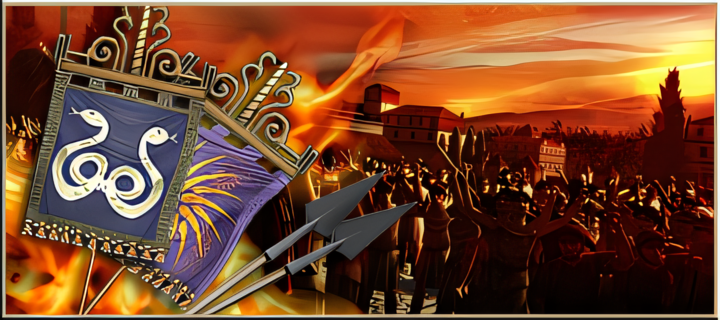
Breaks away: Seleucid Rebels (Upper Satrapies), Ptolemaic Rebels and Miletus from The Seleucid Empire and the Ptolemaic Empire, then the Ptolemaic Dynasts
Four connected rebellions split the Seleucid and Ptolemaic empires. The Seleucid Dynasts, Adaios' breakaway Thracian satrapy, are at large from the start; from turn 20 (266 BC) Hyrkania and Parthia break away from the Seleucid Empire as the Seleucid Satraps; from turn 10 (268 BC) a Lysimachid claimant can raise Miletos against the Ptolemaic Empire as the Ptolemaic Dynasts, and Miletos later breaks away from him as Miletus. Separately, Cyrene rejoins the Ptolemaic Empire when its faction leader is replaced, the death of Magas in the messages.
Any campaign, whether the empires are human or AI: the Seleucid Dynasts exist from the start, the Seleucid Satraps need the Seleucid Empire to hold at least one of their towns, the Lysimachid revolt needs the Ptolemaic Empire to hold Miletos, and Cyrene's return needs a campaign not played as Cyrene.
What sets it off
- The Seleucid Dynasts are alive from the start of the campaign, so their revolt is already under way on the first turn.
- At the start of the Seleucid Empire's first turn from turn 20 (266 BC), each of Zadrakarta, Sirynx-Tambrax, Amardion Phrourion, Tapyron Phrourion, Hekatompylos, Tagai, Apauarktike, Nisa and Derbikon Taphai that the Seleucid Empire still holds revolts, and the Seleucid Satraps (shown as Seleucid Rebels) emerge there.
- The eastern revolt is tried only once, and never if the Seleucid succession revolt has already happened, if the Seleucid Satraps already exist, or if the Seleucid Empire holds none of those towns at that moment.
- From turn 10 (268 BC), at the start of each Ptolemaic Empire turn while it holds Miletos, there is a 35% chance that Miletos revolts and the Ptolemaic Dynasts (shown as Ptolemaic Rebels) emerge there, as long as the Ptolemaic succession revolt has not already happened.
- If the Ptolemaic Dynasts do not appear and Miletos is still Ptolemaic at the start of the Ptolemaic Empire's next turn, the 35% chance rolls again on later turns; if Miletos has passed to anyone else without the Ptolemaic Dynasts appearing, it never rolls again.
- When the AI runs the Ptolemaic Dynasts, Miletos breaks away from them to Miletus on their first turn after more than 4 turns have passed since they emerged.
- When a human plays the Ptolemaic Dynasts, Miletos breaks away from them to Miletus the first time one of their generals captures a settlement other than Miletos.
- When Cyrene gets a new faction leader from turn 4 (270 BC) onwards, Cyrene rejoins the Ptolemaic Empire at the start of the next faction's turn, provided no human plays Cyrene and Cyrene and the Ptolemaic Empire are both still alive; otherwise it never happens.
What happens
- On the Seleucid Dynasts' first turn they take their reserved holding settlement if the Free Peoples hold it.
- A human Seleucid Empire gets the message 'AN UPSTART DYNAST' at the start of their first turn on which the Seleucid Dynasts are alive and at war with them.
- The Seleucid Dynasts give up once the Seleucid Empire has won more than 2 land battles against them, once they get a new faction leader from turn 4 (270 BC) onwards, or once they hold fewer than 3 settlements, their reserved holding settlement included.
- When a human plays neither the Seleucid Empire nor the Seleucid Dynasts, this happens automatically at the start of the next faction's turn while both are alive: every Dynasts settlement except their reserved holding settlement passes to the Seleucid Empire.
- A human Seleucid Empire is instead asked once, at the start of a turn while still at war with the Dynasts, through the message 'The Thracian Satrapy Submits': accepting takes back every Dynasts city except their reserved holding settlement, each with a government building, and declining keeps the war going with no further offer.
- When the Seleucid Dynasts give up, their faction leader, or failing him another family general, is moved to a fixed spot and made immovable and immortal, all their other armies are destroyed, and they become neutral with the Seleucid Empire.
- If those dormant Seleucid Dynasts later hold more than one settlement, the parked general is freed and moved to a fixed spot.
- Human Seleucid Dynasts are never made to give up.
- In the east, the rebelling towns pass to the Seleucid Satraps, which did not exist until now, with garrisons drawn from Seleucid Chalkaspides, Thureophoroi, Greek Hoplites, Greek Peltasts, Greek Archers, Seleucid Xystophoroi, Prodromoi and Neocretan Archers.
- On the Satraps' first turn, every one of those towns held by the Seleucid Empire or the Free Peoples also passes to them, as does every one held by the Parni or Bactria unless a human plays that faction.
- At the same moment the Parni, unless a human plays them, lose every settlement they hold to the Free Peoples and take to the steppe as a horde.
- If Bactria and the Seleucid Empire are both alive, the Seleucid Empire and Bactria are put at war.
- The Satraps are put at war with the Parni, and while the Parni live the Satraps are put back at war with them at the start of each of their turns until the Satraps give up.
- When a human plays neither the Satraps nor the Parni, the Satraps give up automatically once they have played at least one turn and either get a new faction leader, have lost more than 2 settlements since one of their generals last captured one, or hold fewer than 2 settlements, their reserved holding settlement included.
- Their settlements, except their reserved holding settlement, then go to the Parni if they are alive, otherwise to the Seleucid Empire if it is alive, with a government building in each for a human Seleucid player, otherwise to the Free Peoples.
- A human Parni player is instead asked once, through the message 'The Satraps Submit', when the same conditions are met: accepting gives the Parni every Satraps city except their reserved holding settlement, each with a government building, and declining keeps the war going with no further offer.
- When the Satraps give up, their faction leader, or failing him another family general, is moved to a fixed spot and made immovable and immortal, all their other armies are destroyed, and they become neutral with the Parni and the Seleucid Empire.
- If those dormant Satraps later hold more than one settlement, the parked general is freed and moved to a fixed spot, and their reserved holding settlement passes to the Free Peoples.
- Human Seleucid Satraps are never made to give up.
- In the west, Miletos rebels against the Ptolemaic Empire and passes to the Ptolemaic Dynasts, which did not exist until now, with a garrison drawn from Akontistai, Greek Slingers, Greek Archers, Greek Peltasts, Greek Hoplites, Thureophoroi, Ptolemaic Machairophoroi, Ptolemaic Klerouchoi Phalangites, Ptolemaic Klerouchoi Agema, Ptolemaic Basilikon Agema, Prodromoi, Ptolemaic Xystophoroi and Ptolemaic Agema Cavalry.
- On the Ptolemaic Dynasts' first turn their faction leader receives the Lysimachid trait and they take their reserved holding settlement.
- If the Ptolemaic Dynasts still hold Miletos when it breaks away, the city rebels against them and passes to Miletus, which did not exist until now, with a garrison at 0.01 times normal strength drawn from Akontistai, Greek Slingers, Greek Archers, Greek Peltasts, Milesian Horophylakes, Milesian Hoplites, Thureophoroi, Prodromoi and Xystophoroi, and Miletus receives 10,000.
- AI Ptolemaic Dynasts then give up on their next turn, whether or not Miletos was still theirs: every settlement they hold apart from their reserved holding settlement goes to the Seleucid Empire if it is alive, otherwise to the Ptolemaic Empire if it is alive, otherwise to the Free Peoples, with a government building in each for a human Seleucid or Ptolemaic receiver.
- At the same time their faction leader, or failing him another family general, is moved to a fixed spot and made immovable and immortal, all their other armies are destroyed, and they become neutral with the Ptolemaic Empire and the Seleucid Empire.
- If those dormant Ptolemaic Dynasts later hold more than one settlement, the parked general is freed and moved to a fixed spot, and their reserved holding settlement passes to the Free Peoples.
- Human Ptolemaic Dynasts are never made to give up their cities, and on their first capture of a settlement other than Miletos the message 'The Lysimachid Kingdom' names their new goal: Thrace, the Hellespont and the cities of western Asia Minor.
- When Cyrene rejoins the Ptolemaic Empire, every Cyrene settlement passes to the Ptolemaic Empire, with a government building in each for a human Ptolemaic player, and every Cyrene army is destroyed.
- A human Ptolemaic player then gets the message 'The Death of Magas' at the start of their next turn.
- Each of these steps happens only once per campaign.
The settlements that revolt (10):
| Settlement | Held at the campaign start by | Settlement | Held at the campaign start by | Settlement | Held at the campaign start by |
|---|---|---|---|---|---|
| Zadrakarta | Seleucid Empire | Sirynx-Tambrax | Seleucid Empire | Amardion Phrourion | Seleucid Empire |
| Tapyron Phrourion | Seleucid Empire | Hekatompylos | Seleucid Empire | Tagai | Seleucid Empire |
| Apauarktike | Seleucid Empire | Nisa | Seleucid Empire | Derbikon Taphai | Seleucid Empire |
| Miletos | Ptolemaic Empire |
Playing as the rebels
A human Seleucid Empire player is told of Adaios' revolt through the message 'AN UPSTART DYNAST' at the start of their first turn while the Seleucid Dynasts are at war with them; accepting switches the player to the Seleucid Dynasts at the start of the next turn, if the Dynasts still hold a settlement, with a government building in each of their settlements except their reserved holding settlement. The same player is offered the Seleucid Satraps through the message 'Chaos in the East!' at the start of the turn their revolt is set off; accepting switches the player to the Satraps at the start of the next turn on which the Satraps hold a settlement, with a government building in each of their settlements except their reserved holding settlement. When the Seleucid succession revolt breaks out, the same player is offered the Seleucid Dynasts at the start of their next turn ('Asia Minor Secedes from the Empire!') while the Dynasts hold a settlement, and if that offer is declined or not made, the Seleucid Satraps ('The Upper Satrapies revolt!') while the Satraps hold a settlement. A human Ptolemaic Empire player is offered the Ptolemaic Dynasts at the start of their turn after the Dynasts emerge ('Return of the Lysimachids?'), and again at the start of the turn after the Ptolemaic succession revolt breaks out ('War of the Brothers') while the Dynasts hold a settlement. Accepting any of the other offers places a government building in every settlement of that faction except its reserved holding settlement and switches the player to it; declining keeps the player where they are and leaves the rebels to the AI. Human Parni and Bactria players only get 'Chaos in the East!' as information, and no one is offered Miletus or Cyrene.
The in-game messages (11)
AN UPSTART DYNAST
Adaios, your satrap of Thrace, thinks with the backing of his holdings he can simply revolt! Show him why some backwater barbarians aren't enough to challenge you!
(Accept to switch to the Seleucid Dynasts next turn. Deny to remain with the Seleucids.)
The Thracian Satrapy Submits
The revolt in Thrace is broken. The officers of the Seleucid Dynasts offer to hand back every city they still hold if their lives are spared.
(Accept to take back their cities. Deny to fight on.)
Chaos in the East!
due to distance, and succession disputes within the Seleucid Empire, the Satraps of Bactria, Hyrkania, and Parthia have claimed independence! Meanwhile, there are rumours of the Parni, one of the Dahaean tribes setting their sights once more on their now weakened southern neighbours.
(Accept to switch to the Seleucid Satraps next turn. Deny to remain with the Seleucids.)
Chaos in the East!
due to distance, and succession disputes within the Seleucid Empire, the Satraps of Bactria, Hyrkania, and Parthia have claimed independence! Meanwhile, there are rumours of the Parni, one of the Dahaean tribes setting their sights once more on their now weakened southern neighbours.
The Satraps Submit
The breakaway Satraps of Hyrkania and Parthia are beaten. What is left of their realm is offered to us if their men may go home.
(Accept to take their cities. Deny to fight on.)
Return of the Lysimachids?
A member of your royal house who is a descendent of Lysimachos, your former rival, has conspired and revolted with the tyrant of Miletos! He seeks to re-gain his father's former possessions and glory!
(Accept to take command of the Ptolemaic Dynasts. Deny to remain with the Ptolemies.)
The Lysimachid Kingdom
Miletos has broken away from us, but the cause lives on. Our goal now is to rebuild the kingdom of Lysimachos: Thrace, the Hellespont and the cities of western Asia Minor.
The Death of Magas
Magas, the general who revolted from the Ptolemaic Empire and sought to forge his own dynasty, has died, leaving no heir. Because of this, the land of the Kingdom of Cyrene has peacefully transferred back to the Ptolemaic Kingdom
Asia Minor Secedes from the Empire!
With the death of the Seleucid Faction Leader, a rival family member has decided he should be king and has taken all of the Seleucid territory in Asia Minor for himself!
(Accept to take command of the Seleucid Dynasts. Deny to remain with the Seleucids.)
The Upper Satrapies revolt!
With the recent succession crisis in the Seleucid Empire, multiple generals in the Upper Satrapies have decided to break away from the Seleucid Empire, it's full on civil war!
(Accept to take command of the Seleucid Satraps. Deny to remain with the Seleucids.)
War of the Brothers
Your brother has decided he should be Pharaoh and not you, because of this, he's split away from your Kingdom, taking all of Cyrene with him!
(Accept to take command of the Ptolemaic Dynasts. Deny to remain with the Ptolemies.)
Comes after: The Seleucid Revolts, The Ptolemaic Revolt.
Opens the way to: Milesian Reforms, The Seleucid Revolts, The Ptolemaic Revolt.