
Mercenary Karian Light Infantry
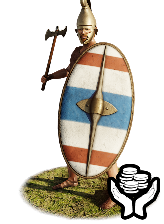
Mercenary. Hired from a regional pool, not recruited from a building.
Class: light · Category: infantry · Men per unit: 40
Description
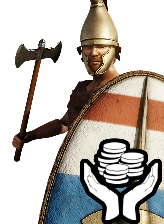
The region of Karia, famous for its Mausoleum and the city to which it belongs (Halikarnassos), is home to strong and hardy troops. These men are protected by large Thureos shields and crested Phrygian and Chalcidian helmets, and carry double edged axes and javelins. They are experts on rough terrain and mainly armed for attack. Unleash them on your enemies, that they may never forget the Karian name!
Historical background
The first mercenary known from history was a Karian. Herodotos relates how the pharaoh Psammetichus I (r. 664-610 BC) hired Karian and Ionian Mercenaries towards the end of his reign, the first such act ever recorded (Hdt. II, 152-154). Karians seem to have been used as mercenaries in Egypt or elsewhere even earlier, as the poet Archilochos (680-645 BC) said "I shall be called a mercenary, like a Karian" (F40). This first use of a word meaning "paid soldiers" shows that even in his time the inhabitants of South Western Anatolia had already gained a certain reputation, and in fact further search shows that Karian mercenaries in Judaean service might be mentioned in the Bible (2 Kings 11.4: they are called Karites here). Pharaoh Amasis (r. 570-526 BC) moved the mercenaries to Memphis, where the Karians built their own neighbourhood in the North West of the city, the Karikon (PSI V, 488). They also retained their own cults and customs, though in the eyes of the Egyptians there were no differences between Ionians and Greeks (cf. Stele of Amasis). They probably saw both as Barbarians – after all, some Karians left graffiti on the walls of Abu Simbel!
Karians continued to emigrate to Egypt for pay and land (see e.g. Polyb. V, 36, 5), but they were also popular in other cities and kingdoms. Demetrios Poliorkets made a Karian garrison commander of Athens at the end of the 4th century (Polyaen. V, 17), the Rhodians relied on Karian mercenaries (Berthold 2018, p. 45), and Polybios often mentions Karian soldiers in the armies of the Antigonid kings. Livy (33.18.9) adds that the Macedonians garrisoned their cities in Karia with local soldiers. Herodotos – himself a Greek from Karia – says that the Karians invented three things: shields with handles, devices on shields, and crests on helmets (Hdt. I, 171). Thanks to the latter, the Persians called the Karians "cocks", and cock comb's helmets are still found on Karian paintings from the late 2nd century BC. While many Karians were equipped similarly to Greek soldiers (Hdt. 7.93), some fought as axemen. After all, the sign of Zeus Labraundos, the highest God of Karia, was a two-bladed axe. Legend has it that the Karians inherited the Labrys from the Amazons and the Heraklid kings of Lydia who had once ruled their lands (Plut. qu. Gr. 45). We have given them the Thureos shield some of them must have adopted during their mercenary service in the 3rd century, and javelins, as these were used by most peoples who lived in mountainous terrain.
Stats
| Rank in roster | ||
|---|---|---|
| Men per unit | 40 | ███······· 30% |
| Attack | 11 | ███······· 34% |
| Charge bonus | 10 | ████······ 35% |
| Defence | 26 | ███······· 32% |
| · armour | 3 | ██········ 21% |
| · defence skill | 18 | ████······ 38% |
| · shield | 5 | ██████···· 57% |
| Morale | 11 | ████······ 39% |
| Discipline | Normal | |
| Training | Trained | |
| Upkeep per turn | 594 dn | ████······ 39% |
Weapons
| Primary | Secondary | Primary | Secondary | Primary | Secondary | Primary | Secondary | ||||
|---|---|---|---|---|---|---|---|---|---|---|---|
| Attack | 11 | 8 | Charge bonus | 10 | 19 | Type | thrown · blade | melee · blade | Damage | piercing | slashing |
| Projectile | javelin | — | Range | 50 | — | Ammunition | 4 | — | Properties | Used just before charging into combat · thrown | Armour-piercing (counts only half the target's armour) |
Defence
| Primary | Secondary | Primary | Secondary | Primary | Secondary | Primary | Secondary | ||||
|---|---|---|---|---|---|---|---|---|---|---|---|
| Total | 26 | — | Armour | 3 | — | Defence skill | 18 | — | Shield | 5 | — |
Condition and terrain
| Hit points | 1 | Ground: scrub / sand / forest / snow | 8 / 0 / 8 / 0 | Charge distance | 30 | Formations | Square |
Technical stats
| Time between blows (primary / secondary) | 2.5 s / 2.5 s | Extra fatigue in hot climates | 0 | Collision mass per man (1.0 is normal) | 0.95 | Spacing between men: close / loose | 1 × 1.2 m / 2 × 2.4 m |
| Default ranks | 5 |
In battle: Can sap · Very good stamina
Where to hire it
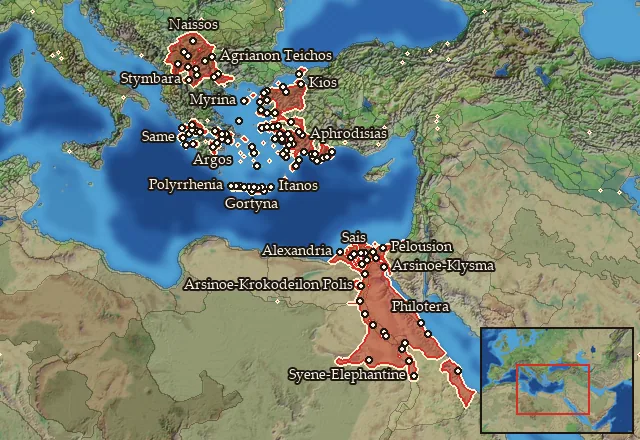
Mercenaries are hired from a regional pool, not recruited from a building. This unit is offered by 20 pools covering 110 regions, at 3,268–3,661 dn to hire and 0–1 experience.
Mercenary pools: Aegean Islands · Aitolia Akarnania · Alexandria · Argolis · Athens · Attica · Boeotia · Caria · Corinth · Crete · Dorian Pentapolis · Egypt · Elis · Ionia · Lycia · Odysseus Islands · Pergamon · Rhodes · Sardis · Troad Mysia
At least one of those pools sells to any faction that has an army in range, with no faction restriction.
Some pools additionally restrict it to Antigonid Kingdom · Athens · Boeotians · Elis · Pergamon · Ptolemaic Empire · Ptolemaic Rebels · Rhodes · Seleucid Empire · Seleucid Rebels (Asia Minor) · Seleucid Rebels (Upper Satrapies).
The 110 regions where this unit appears in a mercenary pool
Acheloos · Agriania · Aitolia · Akarnania · Amphilochia · Anatolike Dardania · Anatolike Kyklades · Ano Troias · Apollonopolites-Latopolites Nomoi · Apteraia · Arabike Aigyptos · Argolis · Arinna · Arktonnesos · Arsinoites-Aphroditopolites Nomoi · Athribites-Leontopolites Nomoi · Attike · Axios · Boiotia · Boreia Trogodytike · Boubastites-Arabia Nomoi · Chalkedonia · Chios · Dardania · Denthelentike · Deuriopos-Pelagonia · Dorian Chersonesos · Dytike Kyklades · Elis · Erigonia · Erythra Thalassa · Euantheia · Galabria · Gortynia · Gynaikopolites Nomos · Halikarnassia · Hermopolites-Kynopolites Nomoi · Heroon Kolpos · Heroopolites-Heliopolites Nomoi · Hierapytnia
…and 70 more.